




Abstract
Objective: To evaluate the efficacy of transcutaneous auricular vagus nerve stimulation (taVNS) in combination with retroauricular glucocorticoid injection for the treatment of chronic tinnitus.
Methods: This prospective, single-arm study enrolled a total of 34 patients with chronic tinnitus. All participants received combined therapy consisting of taVNS and subcutaneous triamcinolone acetonide injection at the retroauricular mastoid sieve area. The interventions were administered over a one-month period, with taVNS delivered twice daily. Assessments were performed at three time points: baseline (T0), immediately post-treatment (T1), and one month after treatment completion (T2). The primary outcome was tinnitus severity, measured using the Tinnitus Functional Index (TFI). Secondary outcomes included sleep quality (Insomnia Severity Index, ISI), anxiety (Generalized Anxiety Disorder-7, GAD-7), and depression (Patient Health Questionnaire-9, PHQ-9).
Results: Significant improvements in tinnitus severity were observed, as reflected by a reduction in TFI scores from baseline to T1 (P = 0.002), with sustained improvement at T2 (P = 0.054). ISI scores also showed significant improvement from T0 to T1 (P = 0.033), with further improvement at T2 (P = 0.011). Although GAD-7 and PHQ-9 scores did not show immediate improvement post-treatment, both decreased significantly by T2 compared with baseline (GAD-7: P = 0.001; PHQ-9: P = 0.004), indicating delayed but meaningful reductions in anxiety and depressive symptoms.
Conclusion: The combined application of taVNS and retroauricular glucocorticoid injection yielded significant reductions in tinnitus severity. While additional controlled studies are warranted, these results offer preliminary evidence that this non-invasive approach may represent a promising therapeutic strategy for chronic tinnitus.
Keywords: tinnitus; auricular vagus nerve stimulation; neuromodulation; glucocorticoid injection
Introduction
Tinnitus, defined as the perception of sound in the absence of an external stimulus, affects more than 740 million adults worldwide [1]. Severe or persistent tinnitus often leads to secondary complications such as sleep disturbances, anxiety, and depression [2]. These comorbidities substantially impair quality of life and impose a considerable burden on healthcare systems [3]. While various therapeutic approaches, such as pharmacological treatments, sound therapy, and retraining therapy, have been investigated, none have yet demonstrated consistent, evidence-based efficacy [4]. Vagus nerve stimulation (VNS) has recently been investigated for the treatment of various conditions, including stroke, epilepsy, depression, Alzheimer’s disease, rheumatoid arthritis, and chronic pain [5-10]. In vivo studies have previously shown that electrical stimulation of the basal forebrain can induce auditory cortical reorganization [11], potentially reversing the pathological plasticity associated with tinnitus. Engineer et al. [12] successfully paired VNS with tones excluding the tinnitus frequency, eliminating both behavioral and physiological signs of tinnitus in a rat model. This effect is mediated, at least in part, by the activation of norepinephrine and acetylcholine pathways [13]. Nevertheless, invasive VNS procedures may lead to complications such as hoarseness or throat discomfort [14]. Transcutaneous auricular vagus nerve stimulation (taVNS) has emerged as a non-invasive alternative, targeting the auricular branch of the vagus nerve (ABVN) [15]. Neuroimaging studies have confirmed that taVNS elicits central effects comparable to those of invasive VNS [16]. However, clinical studies investigating taVNS for tinnitus have yielded inconsistent results [16-22]. Given that previous studies on combined taVNS-based interventions have reported more favorable outcomes for tinnitus treatment compared to taVNS alone, and considering that retroauricular injection is a commonly used administration method in China, the present study is the first to explore the synergistic therapeutic potential of integrating neuromodulation with localized anti-inflammatory therapy in the management of chronic tinnitus.
Materials and Methods
DesignThis prospective clinical study was conducted at the Department of Otolaryngology-Head and Neck Surgery, the First Affiliated Hospital of Anhui Medical University, between November 2022 and June 2023. Our primary aim was to evaluate the efficacy of taVNS combined with retroauricular glucocorticoid injection in patients with chronic tinnitus.
Sample sizeThe sample size was calculated based on the Tinnitus Functional Index (TFI), a widely recognized measure of tinnitus-related distress. A clinically meaningful improvement was defined as a reduction of 13 points on the TFI, with a standard deviation (SD) of 24.7 [23]. With a two-sided α = 0.05 and an effect size of 0.8, 23 participants were required for this study. To account for potential dropout or loss to follow-up, the target sample size was increased to 30 participants. Ultimately, 34 participants were recruited and completed the study protocol.
ParticipantsThe study included participants who met the following inclusion criteria: (1) aged between 18 and 65 years; (2) with subjective tinnitus lasting at least 3 months; and (3) able to read and write in Chinese. Meanwhile, participants were excluded if they met any of the following criteria: (1) diagnosed with or exhibiting objective tinnitus; (2) pregnant at the time of enrollment or with a history of major medical, neurological, or psychiatric conditions; or (3) had metallic implants, such as cardiac stents, pacemakers, or cochlear implants.
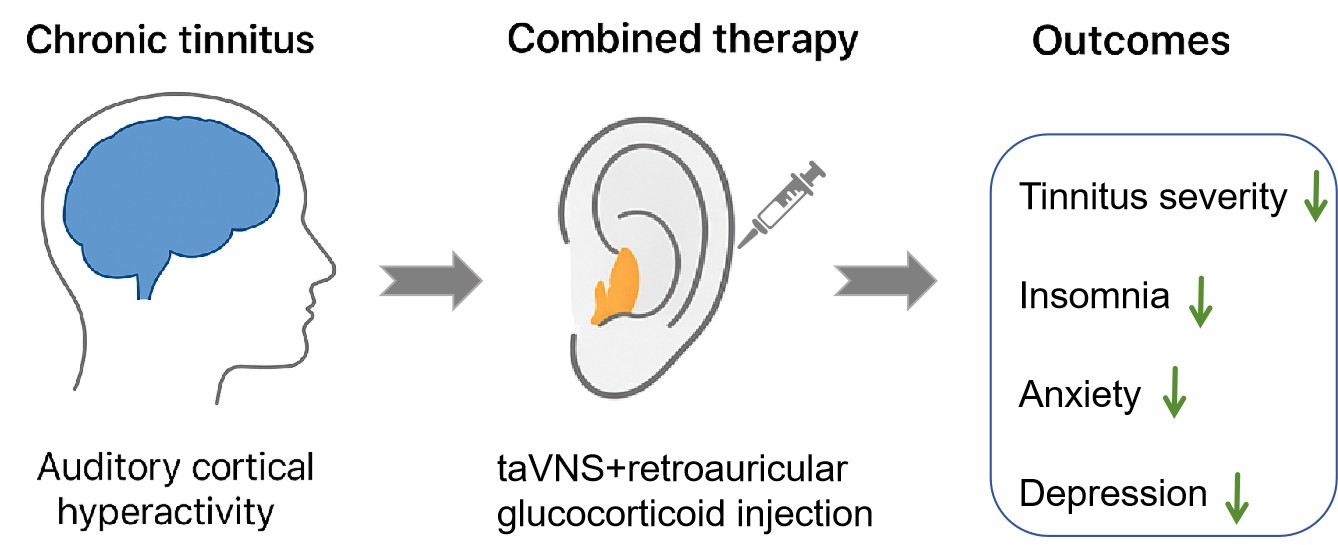
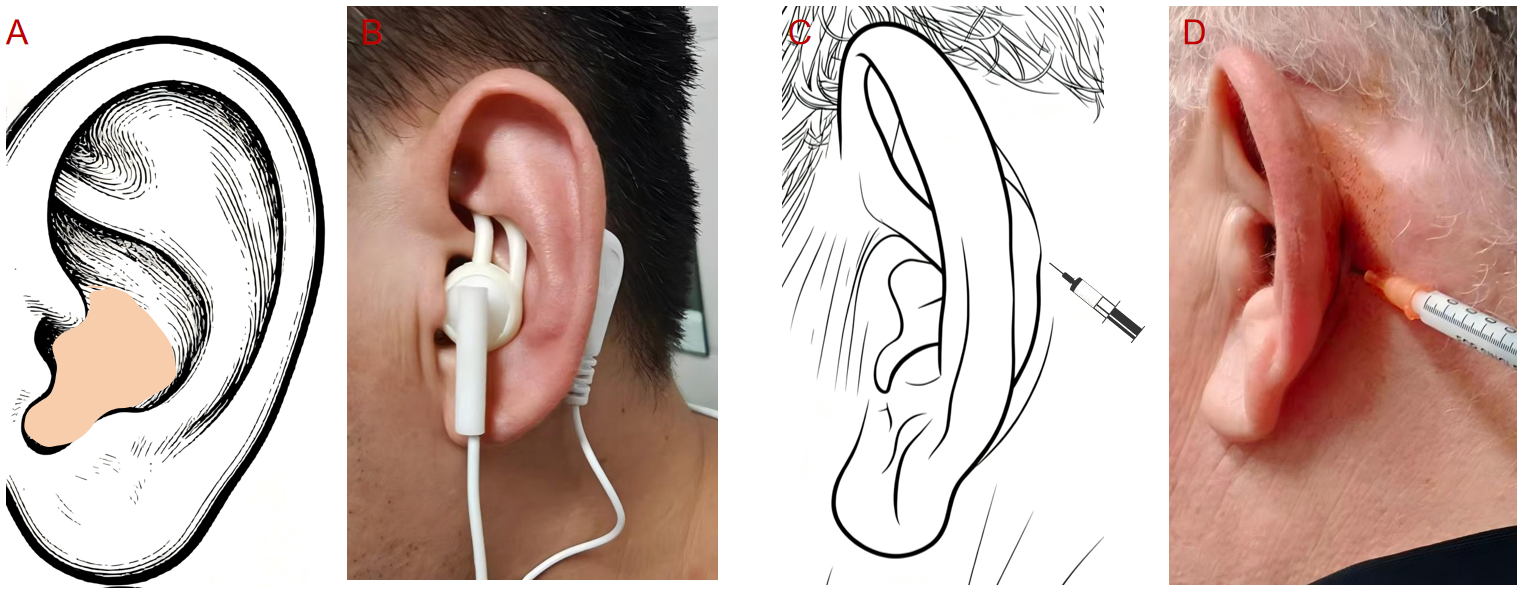
Treatment ProceduresTaVNS was administered using a stimulator device manufactured by Hefei Zhifa Natural Electronic Technology Co., Ltd. The stimulating electrode, shaped like an earplug, was positioned in the cavum conchae. Stimulation parameters were set as follows: a 3-second on/2-second off cycle, a pulse width of 280 μs, and a frequency of 60 Hz. The stimulation intensity was individually adjusted to the maximum tolerable level, defined as the highest intensity at which participants reported a tingling sensation without pain. Each participant received one-hour TaVNS sessions twice a day for a total of one month. The first session was conducted under direct supervision in the outpatient clinic to ensure correct application and assess individual tolerance. A subcutaneous injection of 20 mg triamcinolone acetonide was administered at the mastoid sieve area once every three days, for a total of five sessions (Figure 1).
Figure 1. Study design.
Demographics and tinnitus characteristics (duration, type, laterality) were recorded. Tinnitus severity, as measured by the TFI, was utilized to evaluate the treatment effect in this single-arm study. The TFI is a 25-item self-report questionnaire that assesses the functional impact of tinnitus, with total scores ranging from 0 (no impact) to 100 (maximum impact). The Chinese version of the TFI, which has demonstrated good reliability and validity, was used in the present study [24]. The primary outcome was the change in TFI scores over time, specifically from baseline (T0) to post-treatment (T1) and from baseline (T0) to the 1-month follow-up (T2), to assess both short-term and sustained effects of the intervention. Several validated patient-reported outcome measures were used to assess changes in psychological symptoms, including insomnia, anxiety, and depression, which are commonly associated with chronic tinnitus. These measures included the Insomnia Severity Index (ISI) [25], the Generalized Anxiety Disorder-7 (GAD-7) [26], and the Patient Health Questionnaire-9 (PHQ-9) [27]. The secondary outcomes were defined as the changes in ISI, GAD-7, and PHQ-9 scores over time, particularly from baseline (T0) to post-treatment (T1) and from baseline (T0) to the one-month follow-up (T2). Together, these measures allowed for the evaluation of the intervention's effects on mental health outcomes across the same time intervals (Figure 2).
Figure 2. Schematics of taVNS (A, B) and retroauricular injection.

All statistical analyses were performed using Statistical Package for the Social Sciences (SPSS) software, version 26.0 (IBM Corp., Armonk, NY, USA). For normally distributed continuous variables, data are presented as the mean ± standard deviation (SD). Repeated-measures Analysis of variance (ANOVA) was used to assess changes over time across the three assessment points (T0, T1, and T2). The assumption of sphericity was tested using Mauchly’s test, and when violated, the Greenhouse-Geisser correction was applied to adjust the degrees of freedom. For non-normally distributed continuous variables, data are presented as the median (first quartile, Q1, third quartile, Q3), and the Friedman test was used to examine differences across time points. When significant differences were found using the Friedman test, post hoc pairwise comparisons were conducted with Bonferroni adjustment to control for Type I error due to multiple testing. A two-tailed P-value of less than 0.05 was considered statistically significant for all analyses.
EthicsThis study was conducted in accordance with the principles of the Declaration of Helsinki. It was approved by the Ethics Committee of the First Affiliated Hospital of Anhui Medical University (approval number: PJ2022-11-40) and registered in the Chinese Clinical Trial Registry (ChiCTR2200064549). Written informed consent was obtained from all participants prior to enrollment in the study.
Results
Baseline CharacteristicsA total of 34 patients (19 males and 15 females) were included in the study. The average age of participants was 42.5 ± 12.8 years, with a mean tinnitus duration of 46.2 months. Tinnitus was unilateral in 23 patients (67.6%) and bilateral in 11 patients (32.4%). The majority of participants (20 patients, 58.8%) had high-frequency tinnitus, as determined by tinnitus pitch matching (Table 1).
Table 1. Baseline Characteristics (n = 34)
| Variable | n / Mean | % / SD |
|---|---|---|
| Sex | ||
| Male | 19 | 55.9 |
| Female | 15 | 44.1 |
| Age (years) | 42.5 | 12.8 |
| Duration of tinnitus (months) | 46.3 | 43.5 |
| Laterality of tinnitus | ||
| Unilateral | 23 | 67.6 |
| Bilateral | 11 | 32.4 |
| Tinnitus frequency (kHz) | ||
| Low (0.125–0.25 kHz) | 5 | 14.7 |
| Medium (0.5–2.0 kHz) | 4 | 11.7 |
| High (4.0–8.0 kHz) | 20 | 58.8 |
| Not matched | 5 | 14.7 |
| PTA (0.5, 1, 2, 4 kHz) (dB HL) | 29.4 | 18.4 |
| Tinnitus loudness (dB SL) | 49.7 | 25.5 |
Tinnitus severity, as assessed by the TFI, showed significant improvement over time (P < 0.001). Specifically, TFI scores decreased significantly from baseline (T0) to post-treatment (T1, P = 0.002), and further declined at the one-month follow-up (T2, P < 0.001). However, the difference in TFI scores between T1 and T2 was not statistically significant (P = 0.054), indicating that improvements were achieved mainly by the end of treatment and were maintained at follow-up (Table 2, Table 3). Scores on the ISI, GAD-7, and PHQ-9 all showed significant changes over time (P < 0.001 for all). ISI scores decreased significantly at T1 (P = 0.033) and continued to decline at T2 (P < 0.001). The improvement from T1 to T2 was also statistically significant (P = 0.011), indicating further improvement in sleep quality during the follow-up period. GAD-7 and PHQ-9 scores were comparable at T1 (P > 0.05 for both), but both decreased significantly by T2 compared to baseline (T0) (P = 0.001 for GAD-7; P = 0.004 for PHQ-9) (Table 2, Table 3).
Table 2. Overall Comparison of Tinnitus-Related Outcome Measures Across Three Time Points (n = 34).
| Outcome Measure | T0 (Baseline) | T1 (Post-treatment) | T2 (one-Month Follow-Up) | Z Value | P Value |
|---|---|---|---|---|---|
| TFI | 41.50 (27.25, 49.00) | 32.00 (24.00, 41.25) | 25.50 (20.00, 38.50) | 35.588 | < 0.001 |
| GAD-7 | 4.50 (2.75, 8.25) | 4.00 (2.00, 6.25) | 3.00 (1.00, 6.00) | 15.694 | < 0.001 |
| ISI | 8.50 (4.00, 13.50) | 7.50 (3.75, 10.50) | 4.50 (3.00, 8.50) | 36.541 | < 0.001 |
| PHQ-9 | 4.00 (1.00, 7.25) | 3.00 (0.75, 6.00) | 3.00 (0, 6.00) | 15.622 | < 0.001 |
Table 3. Comparisons of Tinnitus-Related Outcome Measures at Three Time Points (n = 34).
| Outcome Measure | T0 vs T1 | T1 vs T2 | T0 vs T2 | |||
|---|---|---|---|---|---|---|
| Z Value | P Value | Z Value | P Value | Z Value | P Value | |
| TFI | 0.838 | 0.002 | 0.574 | 0.054 | 1.412 | <0.001 |
| GAD-7 | 0.456 | 0.18 | 0.412 | 0.269 | 0.868 | 0.001 |
| ISI | 0.618 | 0.033 | 0.706 | 0.011 | 1.324 | <0.001 |
| PHQ-9 | 0.368 | 0.389 | 0.412 | 0.269 | 0.779 | 0.004 |
P values were adjusted using the Bonferroni correction for multiple comparisons.
No participants experienced any adverse events throughout the study period. Specifically, there were no reports of skin irritation at the stimulation site, dizziness, infection, or any other discomfort associated with the intervention.
Discussion
Tinnitus is a multifactorial disorder often associated with hearing loss. Peripheral auditory deprivation reduces cochlear input to the auditory cortex, leading to increased spontaneous neuronal firing and hyper-synchronization within the auditory neural network [28]. Of note, even in individuals without objective hearing impairment, functional neuroimaging studies have shown that non-auditory brain networks, particularly those involved in attention, emotional processing, and memory (e.g., the prefrontal cortex, amygdala, and insula), also contribute to the persistence and distress associated with tinnitus [29]. These comorbid symptoms, including sleep disturbances, anxiety, and depression, reflect the multisystem nature of tinnitus, driven by both auditory and extra-auditory neuroplastic changes. Given that aberrant neural activity underlies tinnitus perception, it is biologically plausible that targeted neuromodulation could help restore normal neural function and alleviate symptoms [30]. The vagus nerve, composed of approximately 80% afferent sensory fibers and 20% efferent motor fibers, plays a critical role in modulating central nervous system activity through the release of neuromodulators such as norepinephrine and acetylcholine. Preclinical studies have provided compelling evidence for the therapeutic potential of VNS. For instance, Engineer et al. [12] demonstrated that pairing VNS with tones excluding the tinnitus frequency successfully eliminated tinnitus-like behaviors in rats, providing a conceptual foundation for neuromodulation approaches in humans. Building on these insights, taVNS, a non-invasive alternative that stimulates the ABVN, has gained increasing attention as a safe and accessible intervention for tinnitus. Herein, we observed significant improvements in tinnitus severity, sleep quality, and symptoms of anxiety and depression following the combined intervention of taVNS and retroauricular glucocorticoid injection. These improvements likely result from synergistic effects across physiological, neural, and psychological domains. First, taVNS, similar to invasive VNS, is believed to enhance neuroplasticity in both auditory and limbic regions by increasing the release of acetylcholine and norepinephrine, thereby modulating the cortical hyperactivity associated with tinnitus. Second, taVNS may also modulate the autonomic nervous system. As a component of this system, vagus nerve stimulation is believed to enhance vagal tone, which has been linked to improved emotional regulation and alleviation of anxiety and depression symptoms [31]. Third, the retroauricular glucocorticoid injection may exert local anti-inflammatory effects and improve cochlear microcirculation, thereby addressing the underlying factors that contribute to the onset or persistence of tinnitus. Indeed, evidence suggests that local retroauricular drug delivery achieves higher concentrations in the inner ear compared with systemic administration [32]. Our findings are generally consistent with previous studies on taVNS for tinnitus. Lehtimäki et al. [19] and Shim et al. [18] reported beneficial effects of taVNS combined with sound therapy, while Ylikoski et al. [20] found that taVNS paired with habituation therapy alleviated symptoms in 76% of patients after a one-year follow-up. Nonetheless, evidence for taVNS monotherapy remains mixed, with some studies reporting positive outcomes while others show no significant benefit [21]. This variability in treatment response highlights the potential value of combination strategies, such as the taVNS plus retroauricular injection approach employed in our study. This combined regimen has been rarely reported in the international literature and warrants further investigation. The ABVN, responsible for transmitting afferent signals to the nucleus of the solitary tract and activating central neuromodulatory pathways, has a terminal diameter of only about 1 μm, as described by Butt et al. [15]. Due to its small size and complex distribution, precise anatomical mapping of effective stimulation sites remains challenging, and existing anatomical studies are limited. Nevertheless, functional neuroimaging and clinical studies have consistently identified the cymba conchae, cavum conchae, and inner tragus as optimal or commonly used stimulation sites for the auricular vagus nerve. These regions are not only anatomically accessible but also richly innervated by the ABVN, making them ideal for non-invasive neuromodulation. Optimal cortical activation through auricular vagus nerve stimulation is influenced by several stimulation parameters, including pulse width, frequency, "on/off" cycle, current intensity, session duration, and overall treatment period [33]. In the present study, we applied a commonly used pulse width of 280 μs and a suprathreshold current intensity, consistent with prior clinical and experimental protocols. However, the stimulation frequency was set at 60 Hz, which is higher than the more commonly reported range of 20–30 Hz in most previous studies [34]. Current evidence suggests that while frequency is an important parameter, its impact on therapeutic outcomes may be less pronounced than other factors, including current intensity, pulse width, and stimulation duration. Nonetheless, the lack of consensus on the optimal stimulation parameters for tinnitus reflects the need for future studies to systematically evaluate different parameter combinations in order to improve treatment efficacy and consistency. Our study has several limitations that should be acknowledged. First, as a prospective cohort study without a sham or control group, the potential for placebo effects cannot be excluded. This is a common limitation in neuromodulation research, as demonstrated by Tutar et al. [17], who employed a randomized controlled design and observed significant improvements in the sham group, albeit to a lesser extent than in the active taVNS group. Therefore, there is a need to include sham controls in future studies to determine the true treatment effect more accurately. Second, our intervention used a fixed set of stimulation parameters (e.g., 60 Hz, 280 μs, suprathreshold intensity), and the impact of alternative or optimized parameter combinations remains unexplored. Since stimulation parameters are known to influence neuromodulatory outcomes, further research is needed to identify the most effective configurations for tinnitus management. Third, the follow-up period in this study was short, and the sustainability of treatment effects beyond this timeframe remains unclear. Long-term follow-up assessments are necessary to evaluate the durability of clinical benefits and guide clinical decision-making.
Conclusion
In conclusion, our findings suggest that taVNS combined with retroauricular glucocorticoid injection is a safe, non-invasive, and clinically promising approach for reducing tinnitus severity. Nevertheless, given the limitations of the current study design, future multicenter, randomized, controlled, and large-scale trials are needed to confirm its efficacy, optimize stimulation protocols, and establish the long-term therapeutic value of this combined intervention as a viable adjunct in tinnitus management.
Abbreviations
VNS, Vagus Nerve Stimulation; taVNS, Transcutaneous Auric-ular Vagus Nerve Stimulation; ABVN, Auricular Branch of the Vagus Nerve; TFI, Tinnitus Functional Index; ISI, Insomnia Se-verity Index; GAD-7, Generalized Anxiety Disorder-7; PHQ-9, Pa-tient Health Questionnaire-9; SD, Standard Deviation; ANOVA, Analysis of Variance; ChiCTR, Chinese Clinical Trial Registry;
Declarations
Author Contributions
Shanwen Chen: Conceptualization, Methodology, Investigation, Formal analysis, Writing-original draft; Yanxun Han: Conceptu-alization, Investigation, Data curation; Yuchen Liu: Conceptual-ization; Jiaxin Li: Conceptualization; Qiling Shen: Conceptualization; Yichen Li: Conceptualization; Chunhui Tian: Resources; Yehai Liu: Writing-review & editing, Supervision, Project admin-istration, Funding acquisition. All authors contributed to data interpretation and approved the final manuscript.
Acknowledgements
Not Applicable.
Funding information
This work was supported by the Project of Science and Technology of National Health Commission (No. 20003), Anhui Province collaborative research project of Chinese and West-ern medicine for major and difficult diseases (No. 2021-70) and Project of Health Commission of Anhui Province (No. AH-WJ2021b160).
Ethics Approval and Consent to Participate
This study was conducted in accordance with the principles of the Declaration of Helsinki. Ethical approval was obtained from the Ethics Committee of the First Affiliated Hospital of Anhui Medical University (approval number: PJ2022-11-40). The study was also registered in the Chinese Clinical Trial Registry (ChiCTR2200064549). Written informed consent was obtained from all individual participants prior to their enrollment in the study.
Competing Interests
The authors declare no competing interests.
Data availability
The data that support the findings of this study are available from the corresponding author upon reasonable request.
References
 Figures
 References
 Peer
Peer Information
Figure 1. Study design.
Figure 2. Schematics of taVNS (A, B) and retroauricular injection.
Peer-review Terminology
Identity transparency: Single anonymized
Reviewer interacts with: Editor
Details
This is an open access article under the terms of the Creative Commons Attribution License(http://creativecommons.org/licenses/by/4.0/), which permits use, distribution and reproduction in any medium, provided the original work is properly cited.
Publication History
Received 2025-09-19
Accepted 2025-11-10
Published 2025-12-14